
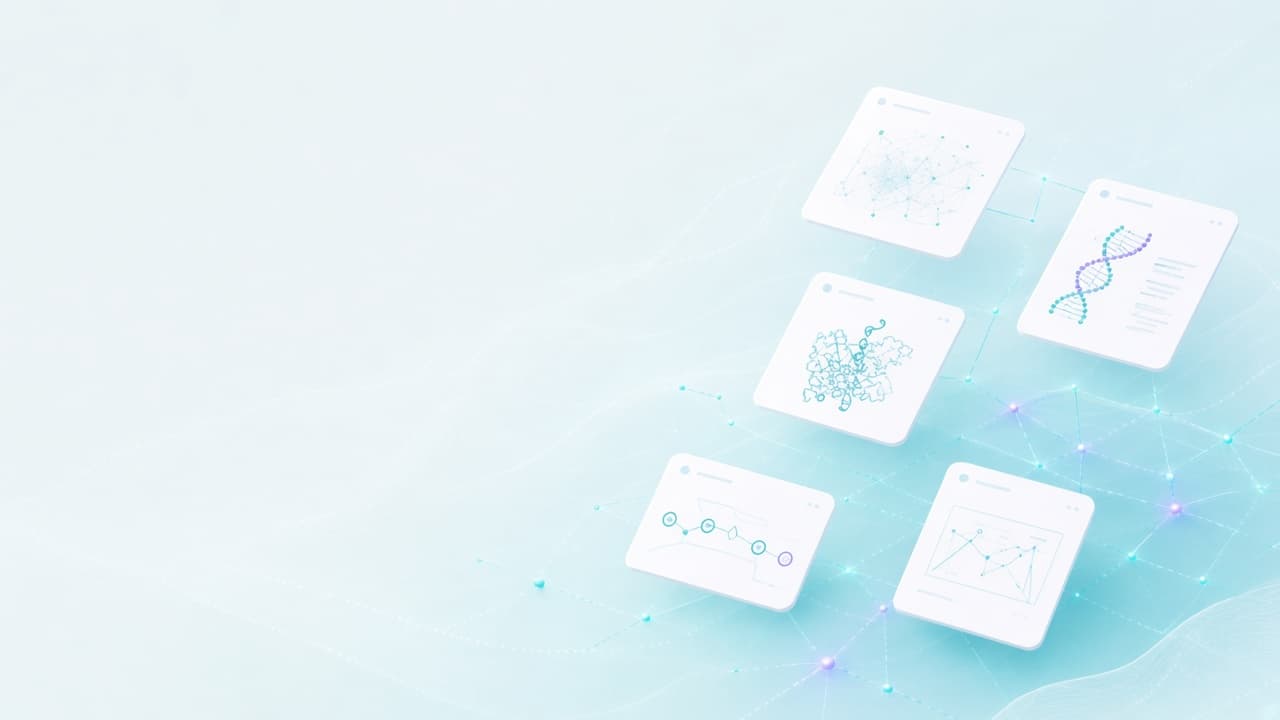
The topic at a glance
- BioAtlas is a free, community-driven knowledge environment for exploring and learning modern life sciences — separate from the OVAITY research platform.
- It exists because the knowledge is already out there, but spread across papers, databases, repositories, company pages, and announcements.
- The first version is a place to learn concepts and methods, explore models and structures, and follow what is changing — and it is meant to grow with the community.
Today I want to share something we have been building at OVAITY: BioAtlas.
BioAtlas is a free, community-driven resource for exploring, understanding, and staying up to date with what is happening across life sciences.
The idea behind it is also personal.
My own background is in computer science, not biology. Over the past years, as I moved deeper into life sciences, I kept finding myself trying to connect the dots: understanding a new concept, discovering a foundation model, following an emerging method, and figuring out who is building what across research and biotech.
There is an extraordinary amount of knowledge out there. It is also scattered — across papers, databases, company websites, GitHub repositories, conference talks, and announcements that disappear into the feed.
So I started building the resource I wished I had when I began this journey.
What BioAtlas is — and what it is not
One distinction matters from the start.
BioAtlas is not the OVAITY Scientific Intelligence Platform.
OVAITY is being built so research teams can keep their own projects, experiments, datasets, analyses, and decisions connected over time. That is a different problem: the memory layer inside an organization, where evidence has to be traceable and context has to survive beyond a figure or a slide deck.
BioAtlas sits on the other side of that line. It is a public knowledge environment for the language and landscape of life science — the concepts, methods, models, structures, and developments that anyone should be able to find and understand.
The two are related, but they serve different jobs.
BioAtlas helps people enter and navigate the field.
OVAITY helps research teams act on their own scientific record.
We kept them separate on purpose. A community resource should not require a commercial relationship. And a research platform should not pretend that public encyclopedic knowledge is the same as a lab’s own evidence.
A place to learn, explore, and stay current
I see BioAtlas serving three complementary purposes.
Learn is about understanding the science.
The Learning Hub is a structured path through modern life science, from the language of biology to how laboratory evidence is created, through genomics, bioinformatics, multi-omics, translation, clinical research, and scientific AI. Guided Sessions put terms back into their methodological context, instead of leaving them as isolated definitions.
That part is especially important to me.
BioAtlas should be useful not only to experienced researchers, but also to people entering the field from computer science, engineering, AI, entrepreneurship, or entirely different backgrounds. In a way, I am one of its first users. As I continue learning life sciences myself, I want BioAtlas to capture that journey and make the path a little easier for the next person.
Explore is about understanding what exists today.
The Atlas is a searchable map of concepts and methods. Models collects biological foundation models as a structured catalogue — each one a node linked to organizations, papers, domains, and use cases, drawing on the open index maintained by bio.rodeo. Structures points toward the 3D resources where molecular evidence actually lives.
The point is not to replace UniProt, the PDB, or a model card. It is to make the connections between them easier to see.
Discover is about staying current.
Intelligence follows developments across life science, biotechnology, and scientific AI. The field does not stand still between textbooks. A map that never updates is already out of date.
Built with the community
This is only the beginning.
The first collection already covers hundreds of concepts and methods, a guided learning path, and a catalogue of biological models. That is a start, not a finished map. Whole parts of the landscape — tools, databases, software, protocols — still need to be connected more tightly.
The ambition is to grow BioAtlas into a living map of modern life sciences: one that becomes better as more people contribute knowledge, suggest resources, and point out what we are missing.
That is why BioAtlas is open. The code is on GitHub. Original glossary, methodology, and learning-path content is licensed under Creative Commons Attribution 4.0. Contributions are welcome, particularly from scientists, educators, bioinformaticians, laboratory professionals, and interdisciplinary learners. [1,2]
It will remain free and community-driven.
Because if we want science to move faster, one of the simplest things we can do is make it easier for people to find, understand, and build upon what others already know.
If you find something that should be included, have feedback, or want to help make BioAtlas better, I would genuinely love to hear from you.
Let’s build it together.
References